Baggio's Back View Becomes a Lasting Image of Football's Quiet Genius
Roberto Baggio’s career is being revisited through an image that says little and suggests almost everything: Baggio's back view, captured as the Italian forward walks away from the pitch. There is no dramatic celebration in the frame, no raised trophy and no close-up designed for television. Instead。viewers see the familiar ponytail, the loose shoulders and the number 10 fading into the distance. That simple angle has gained renewed attention among football fans sharing archive photographs and discussing the player’s unusual place in sporting memory. For many supporters, Baggio's back view feels more personal than a posed portrait because it leaves room for reflection. It presents a star after the noise has ended, when the stadium is still loud but the player appears alone with his thoughts.The image carries a strong connection to the 1994 World Cup final, even when no caption confirms the setting. Baggio’s missed penalty against Brazil remains one of football’s most repeated moments, yet the player’s legacy cannot be reduced to that kick. In photographs from that period, Baggio's back view often shows a figure moving through disappointment without theatrical anger. His posture is neither a collapse nor a protest. It is the body language of someone who understands that a single instant can overwhelm years of work. That tension helps explain why Baggio's back view continues to circulate online. Fans who remember his curled free kicks。delicate touches and sudden changes of direction see the same calm personality in the silhouette. Younger viewers, encountering the image without the full historical context, often read it as a universal scene of defeat and dignity.Photographers have long understood the power of showing an athlete from behind, but Baggio's back view has particular visual details that make it instantly recognizable. The ponytail creates a clean outline against the grass, while the shirt number anchors the picture to a specific era of Italian football. Stadium lights。
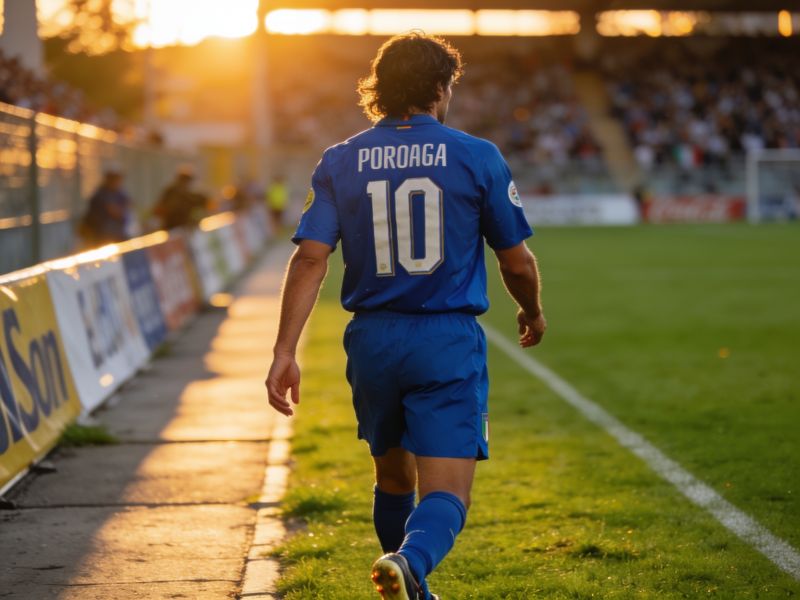
muddy socks and the distance between the player and the camera add a documentary texture that polished promotional images rarely possess. In one widely shared style of photograph, Baggio's back view is framed by empty seats and a goalkeeper waiting near the opposite end. The composition feels almost cinematic, though its emotional force comes from its restraint. There is no need for a caption saying that the match matters. The direction of the player’s steps, and the silence imagined behind him, do the work.Interest in Baggio's back view has also grown because modern football imagery is dominated by instant reaction. Players now turn toward cameras after scoring, perform rehearsed celebrations and communicate directly with millions of followers. Baggio belonged to a different visual culture. His most memorable images often show concentration before a free kick, a quiet conversation with a teammate or the back of his shirt as he crosses the halfway line. That contrast gives Baggio's back view a rare sense of privacy. It does not show the athlete managing his public image;it shows a person temporarily removed from it. Several collectors and fan pages have used the phrase Baggio's back view when posting scans from magazines, match programmes and old newspapers. The wording is plain。
but the response is emotional. Comments frequently mention childhood memories, family viewing rooms and the feeling of watching football before every moment became instantly searchable.There is also a useful warning in the popularity of Baggio's back view. A striking photograph can simplify a complicated career, turning the player into a symbol of melancholy while overlooking his resilience. Baggio returned from serious knee injuries, adapted his game as his pace declined and continued to produce moments of extraordinary skill for Italy and several clubs. His image from behind should not be treated as proof that he was defined by failure. If anything, Baggio's back view works because it leaves the ending open. The player is still moving, still visible and not yet swallowed by the tunnel or the crowd. That is why the phrase remains effective in captions and searches years after his retirement. Baggio's back view is not merely a record of someone leaving the field;it is a compact portrait of a footballer whose influence survived the result. In an era built around constant exposure。Baggio's back view offers something quieter: the dignity of walking on when nobody knows what comes next.
Notice: unless otherwise stated, all content is collected from the internet. If it infringes your rights, please contact us for removal.